Virtualization’s Second Act

I was quite disappointed with the coverage and analysis of VMware’s new vCloud Director (VCD) product, which the company introduced at its annual VMworld conference earlier this month in San Francisco. I think people focused too much on the superficial message of vCD being yet another new cloud platform, but missed the more important insight into what makes this product different from the virtualization we all know so well.

I wrote up my own take on the real change vCD represents in terms of organizational behavior, work flows, and approaches to managing mass virtualization. It was published this week on the VMware blog, so I must have been at least partially right. Go have a look and tell me what you think.

Upcoming Webinar: How To Implement Enterprise-scale API Management: The secret to making your business into a platform.

Jeffery Hammond, Principal Analyst with Forrester Research and I will be jointly delivering a webinar Tuesday, Sept 28th at 9am Pacific time. The topic we are discussing is API management and security. We’ll look at why APIs are important, and discuss the best practices for effectively leveraging these in your business.

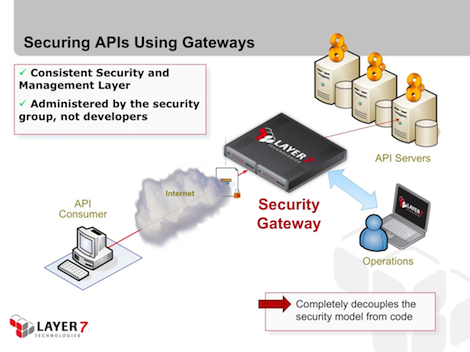
Figure 1: The role of gateways in API management.

This promises to be a very good presentation, and I’d urge you to attend. We’re doing something a little different this time and delivering a much more interactive discussion than some of my past webinars. Since Jeffery and I are both traveling over the next few weeks, we’ve run through our rehearsals early. The material is top notch; Jeffery absolutely understands the issues organizations face as they attempt to expose core business applications using APIs. We are very much on the same page, and I have a strong feeling that this is going to be a very good show. I’m looking forward to it, and I hope you can join us.

You can register for this webinar here.

The Increasing Importance of Cloud Governance

David Linthicum published a recent article in eBizQ noting the Rise of Cloud Governance. As CTO of Blue Mountain Labs, Dave is in a good position to see industry trends take shape. Lately he’s been noticing a growing interest in cloud management and governance tools. In his own words:

This is a huge hole that cloud computing has had.  Indeed, without strong governance and management strategy, and enabling technology, the path to cloud computing won’t be possible.

It’s nice to see that he explicitly names Layer 7 Technologies as one of the companies that is offering solutions today for Cloud Governance.

It turns out that cloud governance, while a logical evolution of SOA governance, has a number of unique characteristics all its own. One of these is the re-distribution of roles and responsibilities around provisioning, security, and operations. Self-service is a defining attribute of cloud computing. Cloud governance solutions need to embrace this and provide value not just for administrators, but for the users who take on a much more active role in the full life cycle of their applications.

Effective cloud governance promotes agility, not bureaucracy. And by extension, good cloud governance solutions should acknowledge the new roles and solve the new problems cloud users face.

How to Secure vCloud Director and the vCloud API

This year’s VMworld conference saw the announcement of VMware’s new vCloud Director product, a culmination of the vision for the cloud computing the company articulated last year and a significant step forward in providing a true enterprise-grade cloud. This is virtualization 2.0—a major rethink about how IT should deliver infrastructure services. VMware believes that the secure hybrid cloud is the future of enterprise IT, and given their success of late it is hard to argue against them.

vCloud Director (vCD) is interesting because it avoids the classic virtualization metaphors rooted in the physical world—hosts, SANs, and networks—and instead promotes a resource-centric view contained with the virtual datacenter (VDC). vCD pools resources into logical groupings that carry an associated cost. This ability to monetize is important not just in public clouds, but for private clouds that implement a charge back to enterprise business units.

Multi-tenancy is a basic assumption in the vCD universe, and the product leverages the new vShield suite to enforce isolation. Management of vCD is through the vCloud API, a technology VMware introduced a year ago, but which has now matured to version 1.0.

The product vision and implementation are impressive; however, a number of security professionals I spoke with expressed disappointment in the rudimentary security and management model for the vCloud API. vCloud is a RESTful API. It makes use of SSL, basic credentials and cookie-based session tokens as a basic security model. While this is adequate for some applications, many organizations demand a more sophisticated approach to governance, buttressed with customized audit for compliance purposes. This is where Layer 7 can help.

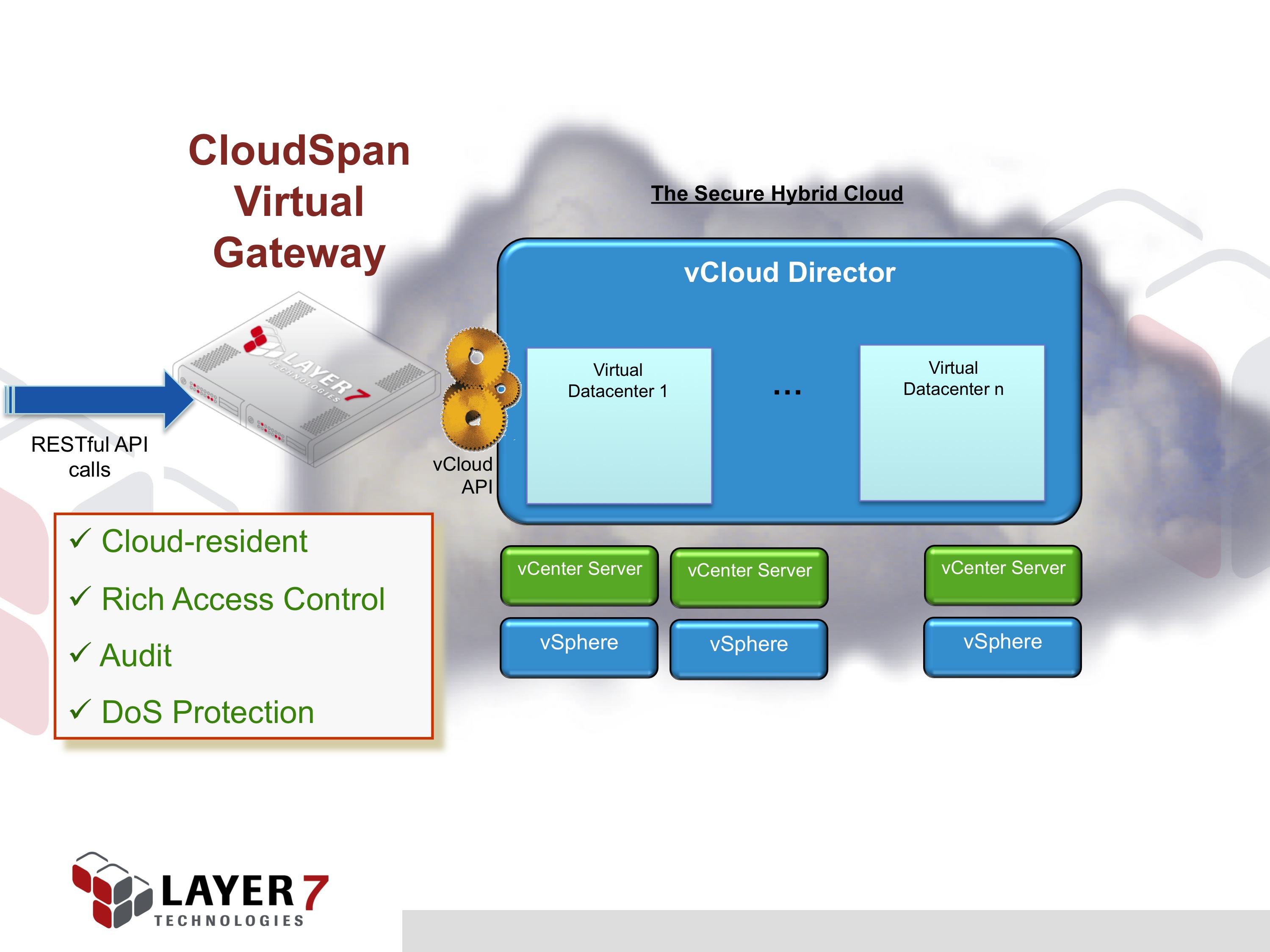
Layer 7’s CloudSpan virtual gateways are the ideal solution for protecting and managing the vCloud API, vSphere, and vCloud Director. CloudSpan provides an intuitive, drag-and-drop interface for securing vCloud services and providing the visibility the modern enterprise demands. Do you need to protect the interface with 2-factor authentication? A few simple key clicks and you add this capability instantly—to a single API, or across a group of similar services. The CloudSpan policy language gives administrators the power to customize the access control and management of vCloud to incorporate:

  • Authentication against virtually any security token (SAML, Kerberos, X.509 certificates, OAuth, etc).
  • Cloud single sign-on (SSO).
  • Fine grained authorization to individual APIs.
  • Fully customizable audit.
  • Virtualization and masking of APIs.
  • Versioning of REST and SOAP APIs beyond vCloud basic versioning.
  • Augmentation and extension of existing vCloud functions.
  • Transformation of any GET, POST, DELETE, and PUT content.
  • Orchestration to create new APIs
  • Validation of XML structures such as OVF containers.
  • Threat detection, including threats embedded in XML OVF files.
  • Automatic fail-over between hosts.
  • Mapping between SOAP and REST
  • JSON Schema validation
  • Management of federated relationships.
  • Live dashboard monitoring of API usage.
  • etc

Figure 1: vCloud Director API management and security with CloudSpan from Layer 7.

CloudSpan is the basis of real cloud governance. In contrast to other solutions that run as third party services or attempt to broker security from you own local data center, CloudSpan runs as an integral part of the vCloud Director environment. CloudSpan runs as a VMware virtual image that is easily incorporated into any VMware virtual infrastructure. At Layer 7,we fundamentally believe that the security, monitoring and visibility solution for cloud APIs must reside inside the cloud they are protecting—not off at some other location where the transactions they proxy are subject to attach as they traverse the open Internet. Local integration of the security solution as an integral part of the cloud infrastructure is the only way to properly secure cloud APIs with sophisticated access control and to offer protection against denial-of-service (DoS) attacks.

For more information about how to secure and manage the vCloud API and vCloud Director, please see the cloud solutions page at Layer 7 Technologies.

Public vs. Private Clouds

Christian Perry has an article in Processor Magazine that I contributed some quotes to. The article is about the ongoing debate about the merits of public and private clouds in the enterprise.

One of the assertions that VMWare made at last week’s VMWorld conference is that secure hybrid clouds are the future for enterprise IT. This is a sentiment I agree with. But I also see the private part of the hybrid cloud as an excellent stepping stone to public clouds. Most future enterprise cloud apps will reside in the hybrid cloud; however, there will always be some applications, such as bursty web apps, that can benefit tremendously from the basic economics of public clouds.

The Top 50 Cloud Bloggers

I’m happy to learn that I’ve made Cloud Computing Journal’s list of the Top 50 Bloggers in Cloud Computing.

What, Me Worry?

According to Yahoo news Infrastructure Services Users Worry Less About Security. This article references a Yankee Group study that found although security remains a top barrier slowing the adoption of cloud services in the enterprise, most companies that have adopted Infrastructure-as-a-Service (IaaS) worry less about security once they begin using the technology.

Once they’ve made the leap into the cloud, the article suggests, users conclude that the security issues aren’t as significant as they had been led to believe. I find myself in partial agreement with this; the industry has created a level of hysteria around cloud security that isn’t necessarily productive. Taking pot shots at the security model in the cloud is pretty easy, and so many do—regardless of whether their aim is true (and for many, their aim is not).

Nevertheless, my interpretation of these results is that they are uncovering less a phenomenon of confidence genuinely earned and more a case of misplaced trust. The article makes an interesting observation about the source of this trust:

Twenty-nine percent of the companies in the survey viewed system integrators as their most trusted suppliers of cloud computing. But among early adopters of IaaS, 33 percent said they turn to telecom companies first.

Do you remember, back around the turn of the century, when large-scale PKI was first emerging? The prevailing wisdom was that state-sponsored PKI should be administered by the post offices because this organization above all was perceived as trustworthy (as well as being centralized and a national responsibility). Hong Kong, for instance, adopted this model. But in general, the postal-run PKI model didn’t take hold, and today few federal post services are in the business of administering national identity. Trust doesn’t transfer well, and trust with letters and packages doesn’t easily extend to trust with identity.

Investing generalized trust in the telcos reminds me of the early PKI experience. The market is immature, and because of this so too are our impressions. Truthfully, I think that the telcos will be good cloud providers—not because I have an inherent trust in them (I actively dislike my cell provider on most days), but because the telcos I’ve spoken to that have engaged in cloud initiatives are actually executing extremely well. Nevertheless, I don’t think I should trust them to secure my applications. This is ultimately my responsibility as a cloud customer, and because of I can’t reasonably trust any provider entirely, I must assume a highly defensive stance in how I secure my cloud-resident applications.

I hope my provider is good at security; but I need to assume he is not, and prepare myself accordingly.

My New Book, Cloud Computing: Principles, Systems and Applications, is Now Available

I’m happy to announce that I have a paper published in a new cloud computing textbook published by Springer. The book is called Cloud Computing: Principles, Systems and Applications. The paper I wrote is Technologies for Enforcement and Distribution of Policy in Cloud Architectures. If you click on the link you should be able to preview the abstract and the first few pages online.

The editors of the book are Dr. Nick Antonopoulos, who is Professor and Head of the School of Computing at the University of Derby, UK and Dr. Lee Gillam, who is a Lecturer in the Department of Computing at the University of Surrey, UK. I participated on the review committee for the text, and Drs. Antonopoulos and Gillam have pulled together an excellent compilation of work. Although this book is intended as an academic work of primary interest to researchers and students, the content is nevertheless very timely and relevant for IT professionals such as architects or CTOs.

Lately much of my writing has been for a commercial audience, so it was nice to return to a more academic style for this chapter. I’ve carefully avoided book commitments for the last few years, but the opportunity to publish in a Springer book, a publisher I’ve always considered synonymous with serious scientific media, was just too good to pass up. Every book project proves to be more work than the author first imagines, and this was no exception (something to which my family will attest). But I’m very happy with the results, and I hope that this text proves its value to the community.

Why Health Care Needs SOA

A recent article in DarkReading offers a powerful argument as to why the health care sector desperately needs to consider Service Oriented Architecture (SOA). In her piece Healthcare Suffers More Data Breaches Than Financial Services So Far This Year, Erika Chickowski cites a report indicating that security breeches in health care appear to be on the rise this year, with that sector reporting over three times more security incidents than the financial services industry.

I worked for many years in a busy research hospital, and frankly this statistic doesn’t surprise me; health care has all of the elements the lead to the perfect storm of IT risk. If there is one sector that could surely benefit from adopting SOA as a pretext to re-evaluate security as a whole, it is health care.

Hospitals and the health care eco-system that surround these are burdened with some of the most heavily siloed IT I have ever seen. There are a number of reasons why this is so, not the least of which is politics that often appear inspired by the House of Borgia. But the greatest contributing factor is the proliferation of single-purpose, closed and proprietary systems. Even the simplest portable x-ray machine has a tremendously sophisticated computer system inside of it. The Positron Emission Tomography (PET) systems that I worked on included racks of what at the time were state-of-the-art vector processors used to reconstruct massive raw data sets into understandable images. Most hospitals have been collecting systems like this for years, and are left with a curiosity cabinet of samples representing different brands and extant examples of nearly every technological fad since the 1970s.

I’m actually sympathetic to the vendors here because their products have to serve two competing interests. The vendors need to package the entire system into a cohesive whole with minimal ins and outs to ensure it can reasonably pass the rigorous compliance necessary for new equipment. The more open a system is, the harder it is to control the potential variables, which is a truism also in the security industry.  Even something as simple as OS patching needs to go through extensive validation because the stakes are so high. The best way to manage this is to close up the system as much as reasonably possible.

In the early days of medical electronics, the diagnostic systems were very much standalone and this strategy was perfectly sound. Today, however, there is a need to share and consolidate data to potentially improve diagnosis. This means opening systems up—at least to allow access to the data, which when approached from the perspective of traditional, standalone systems, usually means a pretty rudimentary export. While medical informatics has benefited some from standardization efforts, the medical systems still generally reduce to islands of data connected by awkward bridges—and it is out of this reality that security issues arise.

Chickowski’s article echos this, stating:

To prevent these kinds of glaring oversights, organizations need to find a better way to track data as it flows between the database and other systems.

SOA makes sense in health care because it allows for effective compartmentalizing of services—be these MRI scanners, lab results, or admission records—that are governed in a manner consistent with an overall security architecture. Good SOA puts security and governance upfront. It provides a consistent framework that avoids the patchwork solutions that too easily mask significant security holes.

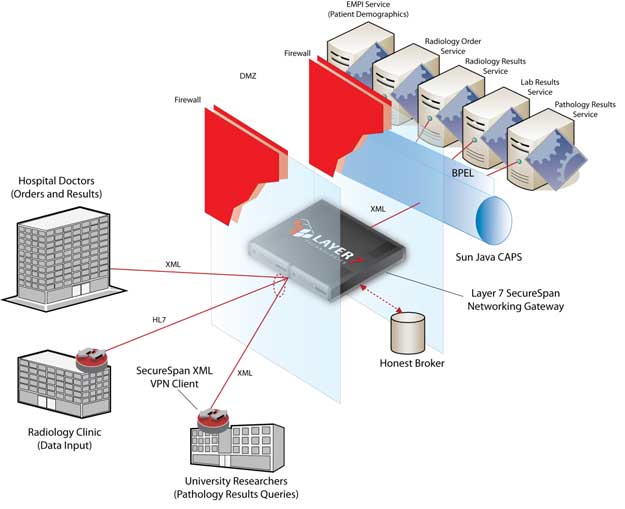
A number of forward-looking health providers have adopted a SOA strategy with very positive results. Layer 7 Technologies partnered with the Universitry of Chicago Medical Center (UCMC) to build a SOA architecture for securely sharing clinical patient data with their research community. One of the great challenges in any medical research is to gather sample populations that are statistically significant. Hospitals collect enormous volumes of clinical data each day, but often these data cannot be shared with research groups because of issues in compliance, control of collection, patient consent, etc. UCMC uses Layer 7’s SecureSpan Gateways as part of its secure SOA fabric to isolate patient data into zones of trust. SecureSpan enforces a boundary between clinical and research zones. In situations where protocols allow clinical data to be shared with researchers, SecureSpan authorizes its use. SecureSpan even scrubs personally identifiable information from clinical data—effectively anonymizing the data set—so that it can be ethically incorporated into research protocols.

The UCMS use case is a great example of how SOA can be a protector of information, promoting the valuable use of data while ensuring that only the right people have access to the right views of that information.
To learn more about this use case, take a look at the detailed description available on the Layer 7 Technologies web site.

Timing Side Channel Attacks

I had an interesting discussion with Bob McMillian of IDG yesterday about the potential for timing attacks in the cloud. Timing attacks are a kind of side channel attack that is based on observed behavior of a cryptographic system when fed certain inputs. Given enough determinism in the response time of the system, it may be possible to crack the cryptosystem based on a statistical sampling of its response times taken over many transactions.

Bob was interested in my thoughts about the threat this attack vector represents to cloud-resident applications. It’s an interesting question, because I think that the very characteristics of the cloud that people so often criticize when discussing security—that is, multi-tenancy and the obfuscation of actual physical resources by providers—actually work to mitigate this attack because they add so much non-deterministic jitter to the system.

Bob’s excellent article got picked up by a number of sources, including ComputerWorld, LinuxSecurity, InfoWorld. It’s also been picked up by the mainstream media, including both San Francisco Chronicle and the New York Times.