Tag Archives: security

REST Security Does Exist—You Just Need To Apply It

On the eve of the RSA conference this year, Chris Comerford and Pete Soderling published a provocative article in Computerworld titled Why REST security doesn’t exist. It’s a prelude to a talk the author’s are delivering at the conference. Their premise is that while good REST security best practices do indeed exist, developers just don’t seem to follow them.

Comerford and Sodering attribute this state of affairs to a combination of two things. First, REST lacks a well-articulated security model. Few would argue with this—REST, by virtue of its grassroots origins, suffers from a security just-do-it-like-the-web nonchalance that’s certainly done it no favors.

The second issue concerns developers who tend to rush implementation without giving due consideration to security. Truthfully, this is the story of security across all of IT, but I might suggest that with REST, the problem is especially acute. The REST style owes much of its popularity to being simple and fast to implement, particularly when faced with the interest-crushing complexity and tooling demands of the WS-* stack. It’s reasonable to think that in the enthusiastic dash to cross the working application finish line, that security is conveniently de-emphasized or forgotten altogether.

REST, of course, can be secured, and the author’s offer sound advice to accomplish this deceptively simple task. They recommend that API developers:

  • “Do employ the same security mechanisms for your APIs as any web application your organization deploys. For example, if you are filtering for XSS on the web front-end, you must do it for your APIs, preferably with the same tools.
  • Don’t roll your own security. Use a framework or existing library that has been peer-reviewed and tested. Developers not familiar with designing secure systems often produce flawed security implementations when they try to do it themselves, and they leave their APIs vulnerable to attack.
  • Unless your API is a free, read-only public API, don’t use single key-based authentication. It’s not enough. Add a password requirement.
  • Don’t pass unencrypted static keys. If you’re using HTTP Basic and sending it across the wire, encrypt it.
  • Ideally, use hash-based message authentication code (HMAC) because it’s the most secure. (Use SHA-2 and up, avoid SHA & MD5 because of vulnerabilities.) “

I agree with this advice. And just to demonstrate how easy it is to implement, I’ve constructed a simple policy for the Layer 7 Technologies SecureSpan Gateway demonstrating their directives:
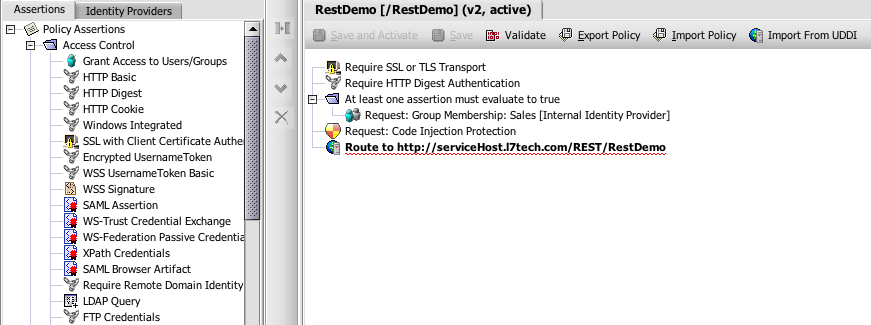
In this policy, I’m ensuring that the REST client is using SSL for three things: confidentiality, integrity, and server authentication. I could require client-side certificate authentication here, but instead I’m using HTTP digest, to emphasize the requirement to avoid using plain text HTTP basic or simple user keys. I’m authorizing access based on group membership here, restricting access to members of the sales group.

Finally, I’ve added a scan for cross site scripting attacks.
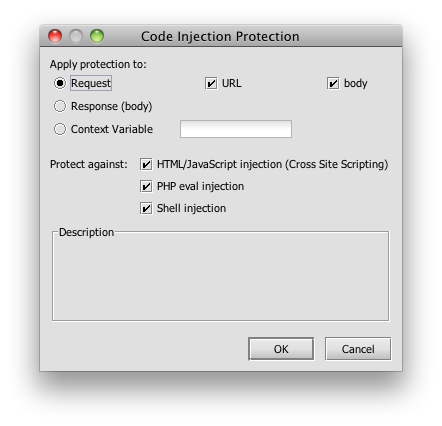
In the interest of deeper vigilance, I’m also searching for PHP and shell injection signatures. This is admittedly broad, but it covers me in case the developer of the service changes implementation without warning.

This last point—that there is an explicit separation made between developers and the security administrators writing and enforcing policy—is an important one. Developers will be developers: some will be rigorous about implementing security best practices; others won’t be. The only way to manage this is to assume a defensive posture in service policy, both from the perspective of incoming transactions, but also around the services themselves. The best practice here is to externalize policy enforcement and assign dedicated security professionals to administer policy.

This defensive approach to securing REST services fits well with the spirit of Comerford and Soderling’s directives. It addresses, in particular, their point about leveraging peer-reviewed frameworks. This is precisely what Layer 7’s SecureSpan Gateway is—a peer-reviewed security framework offering great depth of functionality. SecureSpan is undergoing Common Criteria Review of its implementation, as well as the entire development process for the product. We’re certifying to EAL4+, which is particularly rigorous. This provides assurance that the technology is sufficiently robust for deployment at the highest levels of military and the government. Common Criteria is an arduous process, and going through it demonstrates Layer 7’s deep commitment to security. You should not ever consider a security gateway—for REST, or for XML messaging—that isn’t undergoing the Common Criteria evaluation. Remember, Common Criteria is a necessary stamp of approval for governments around the world; it should also be a basic requirement for you.

Try SecureSpan yourself, and see how you can implement robust application security and monitoring without changing code. Download an evaluation of the SecureSpan virtual appliance right here.

My Thoughts on Cloud Security in SearchCloudComputing.com

I had a good talk the other day with Carl Brooks, the technology writer for SearchCloudComputing.com. We spoke about why security is different in the cloud, and what you can learn from approaches like SOA about how to secure cloud-based apps. The full interview is the lead story today on SearchCloudComputing.com.

How to Safely Publish Internal Services to the Outside World

So you’ve bought into the idea of service-orientation. Congratulations. You’ve begun to create services throughout your internal corporate network. Some of these run on .NET servers; others are Java services; still others are Ruby-on-Rails—in fact, one day you woke up and discovered you even have a mainframe service to manage. But the question you face now is this: how can all of these services be made available to consumers on the Internet? And more important, how can you do it securely?

Most organizations buffer their contact with the outside world using a DMZ. Externally facing systems, such as web servers, live in the DMZ. They mediate access to internal resources, implementing—well, hopefully implementing—a restrictive security model. The DMZ exists to create a security air gap between protocols. The idea is that any system deployed into the DMZ is hardened, resilient, and publishes a highly constrained API (in most cases, a web form). To access internal resources, you have to go through this DMZ-based system, and this system provides a restricted view of the back-end applications and data that it fronts.

The DMZ represents a challenge for publishing services. If services reside on internal systems, how can external clients get through the DMZ and access the service?

Clearly, you can’t simply start poking holes in firewall #2 to allow external systems to access your internal providers directly; this would defeat the entire purpose of the DMZ security model. But this is exactly what some vendors advocate. They propose that you implement local security agents that integrate into the container of the internal service provider. These agents implement policy-based security—essentially taking on the processing burden of authentication, authorization, audit, confidentiality, integrity and key management. While this may seem attractive, as it does decouple security into a purpose-built policy layer, it has some very significant drawbacks. The agent model essentially argues that once the internal policy layer is in place, the internal service provider is ready for external publication. But this implies poking holes in the DMZ, which is a bad security practice.  We have firewalls precicely because we don’t want to harden every internal system to DMZ-class resiliancy. An application-layer policy agent does nothing to defeat OS-targetted attacks, which means every service provider would need to be sufficiently locked down and maintained. This becomes unmanagable as the server volume grows, and completely erodes the integrity of firewall #2.

Furthermore, in practice, agents  just don’t scale well. Distribution of policy among a large number of distributed agents is a difficult problem to solve. Policies rapidly become unsynchronized, and internal security practices are often compromised just to get this ponderous and dependent system to work.

At Layer 7 we advocate a different approach to publishing services that is both scalable and secure. Our flagship product, the SecureSpan Gateway, is a security proxy for Web services, REST, and arbitrary XML and binary transactions. It is a hardened hardware or virtual appliance that can be safely deployed in the DMZ to govern all access to internal services. It acts as the border guard, ensuring that each transaction going in or out of the internal network conforms to corporate policy.

SecureSpan Gateways act as a policy air-gap that constrains access to back end services through a rich policy-based security model. This integrates consistently with the design philosophy of the DMZ. Appliances are hardened so they can withstand Internet-launched attacks, and optimized so they can scale to enormous traffic loads. We built full clustering into SecureSpan in the first version we released, close to eight years ago. This ensures that there is no single point of failure, and that systems can be added to accommodate increasing loads.

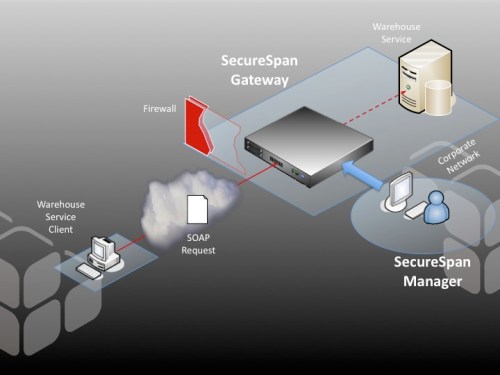
The separate policy layer—and the policy language that defines this—is the key to the security model and is best illustrated using a real example. Suppose I have a warehouse service in my internal network that I would like to make available to my distributors. The warehouse service has a number of simple operations, such as inventory queries and the ability to place an order. I’ll publish this to the outside world through a SecureSpan Gateway residing in the DMZ, exactly as shown in the diagram above.

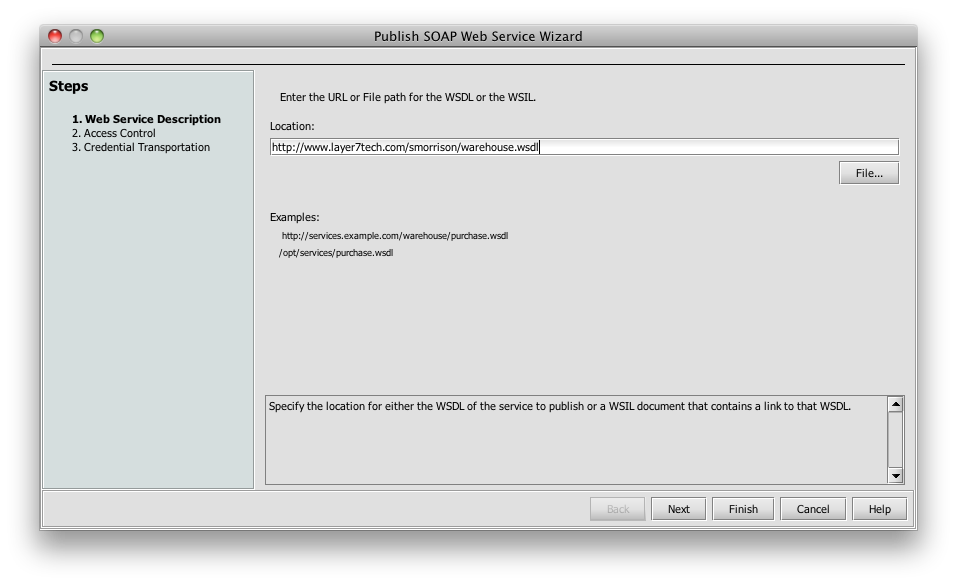
SecureSpan provides a management console used to build the policies that govern access to each service. Construction of the initial policy is made simple using a wizard that bootstraps the process using the WSDL, which is a formal service description for my warehouse service. The wizards allows me to create a basic policy in three simple steps. First, I load the WSDL:

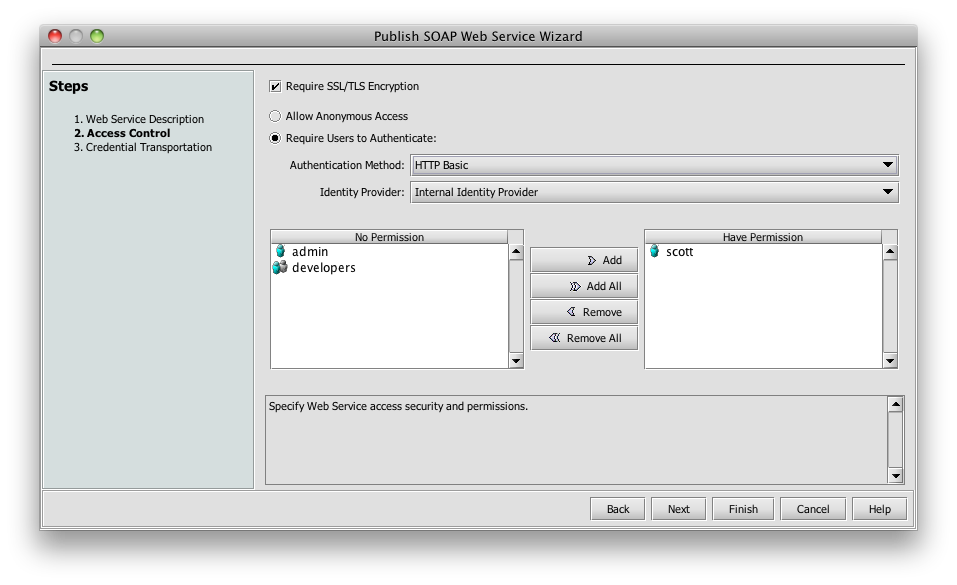
Next, I declare a basic security model. I’ll keep this simple, and just use SSL for confidentiality, integrity, and server authentication. HTTP basic authentication will carry the credentials, and I’ll only authorize access to myself:

If this policy sounds familiar, it’s because it’s the security model for most web sites. It turns out that this is a reasonable model for many XML-based Web services as well.

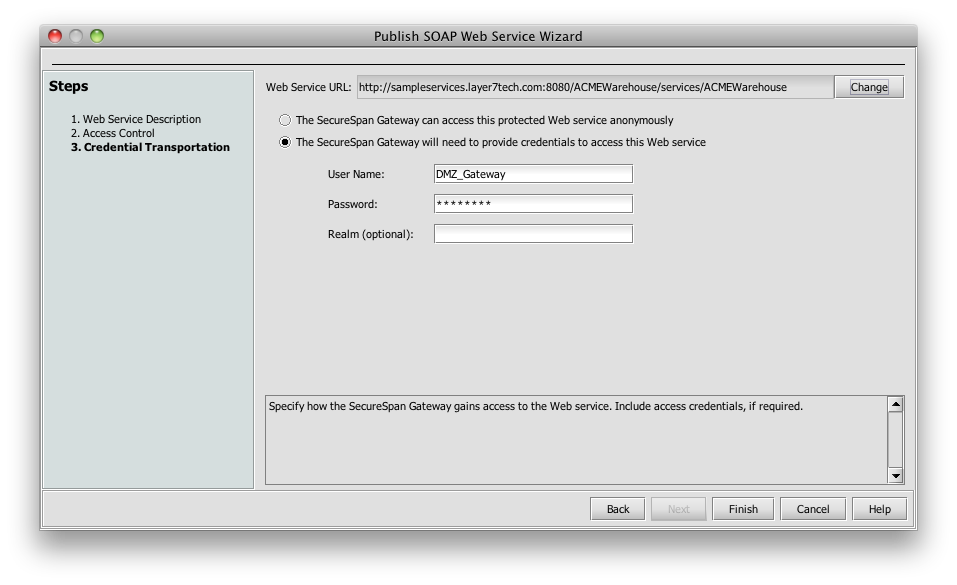
Finally, I’ll define a proxy routing to get to my internal service, and an access control model once there. In this example, I will just use a general account. Under this model, the service trusts the SecureSpan Gateway to authenticate and authorize users on it’s behalf:

You may have noticed that this assumes that the warehouse services doesn’t need to know the identity of the original requester-—that is, Scott. If the service did need this, there are a number of ways to communicate my identity claim downstream to the service, using techniques like SAML, IBM’s Trust Association Interceptor (TAI), proxied credentials, or various other tricks that I won’t cover here.

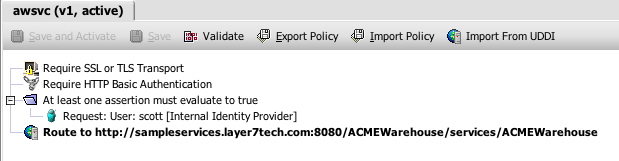
The wizard generates a simple policy for me that articulates my simple, web-oriented security model. Here’s what this policy looks like in the SecureSpan management console:

Policy is made up of individual assertions. These encapsulate all of the parameters that make up that operation. When a message for the warehouse service is identified, SecureSpan loads and executes the assertions in this policy, from top to bottom. Essentially, policy is an algorithm, with all of the classic elements of flow control. SecureSpan represents this graphically to make the policy simple to compose and understand. However, policy can also be rendered as an XML-based WS-Policy document. In fact, if you copy a block of graphical assertions into a text editor, they resolve as XML. Similarily, you can paste XML snippets into the policy composer and they appear as graphical assertion elements.

This policy is pretty simplistic, but it’s a good foundation to build on. I’ll add some elements that further restrict transactions and thus constrain access to the back end system the SecureSpan Gateway is protecting.

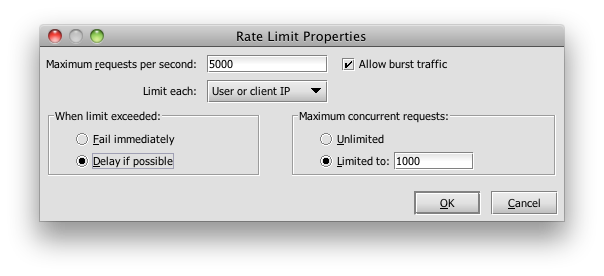
The rate limit assertion allows me to cap the number of transactions getting through to the back end. I can put an absolute quota on the throughput: say, 30,000 transaction/sec because I know that the warehouse service begins to fail once traffic exceeds this volume. But suppose I was having a problem with individual suppliers overusing particular services. I could limit use by an individual identity (as defined by an authenticated user or originating IP address) to 5,000 transasctions/sec—still a lot, but leaving headroom for other trading partners. The rate limit assertion gives me this flexibility. Here is its detailed view:

Note that if I get 5,001 transactions from a user in one second, I will buffer the last transaction until the rate drops in a subsequent time window (subject, of course, to resource availability on the gateway). This provides me with application-layer traffic shaping that is essential in industries like telco, who use this assertion extensively.

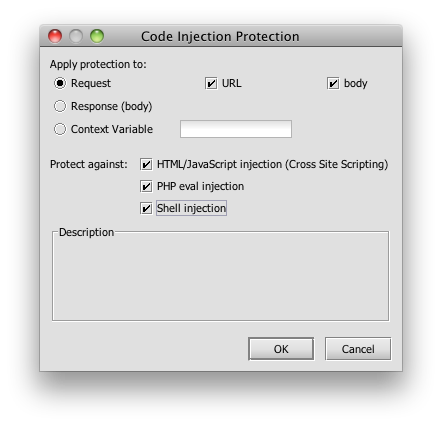
I would also like to evaluate each new transaction for threats. SecureSpan has assertions that cover a range of familar threats, such as SQL-injection (which has been around for a long time, but has become newly relevant in the SOA world), as well as a long list of new XML attacks that attempt to exploit parser infrastructure and autogenerated code. For the warehouse service, I’m concerned about code-injection attacks. Fortunately, there’s an assertion for that:

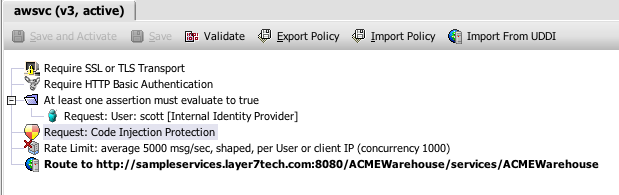
Here’s what these two assertions look like dropped into the policy:

This policy was simple to compose (especially since we had the wizard to help us). But it is also very effective. It’s a visible and understandable, which is an important and often overlooked aspect of security tooling. SOA security suffers from an almost byzantine complexity. It is much too easy to build a security model that obscures weakness behind its detail. One of the design goals we had at Layer 7 for SecureSpan was to make it easy to do the simple things that challenge us 80% of the time. However, we also wanted to provide the richness to solve the difficult problems that make up the other 20%. These are problems such as adaptation. They are the obscure impedance-mismatches between client and server security models, or fast run-time adaptation of message content to accommodate version mismatches.

In this example, it took only seven simple assertions to build a basic security policy for publishing services to the outside world. Fortunately, there are over 100 other assertions—covering everything from message-based security to transports like FTP to orchestration—that are there when you need to solve the tougher problems.

Visualizing the Boundaries of Control in the Cloud

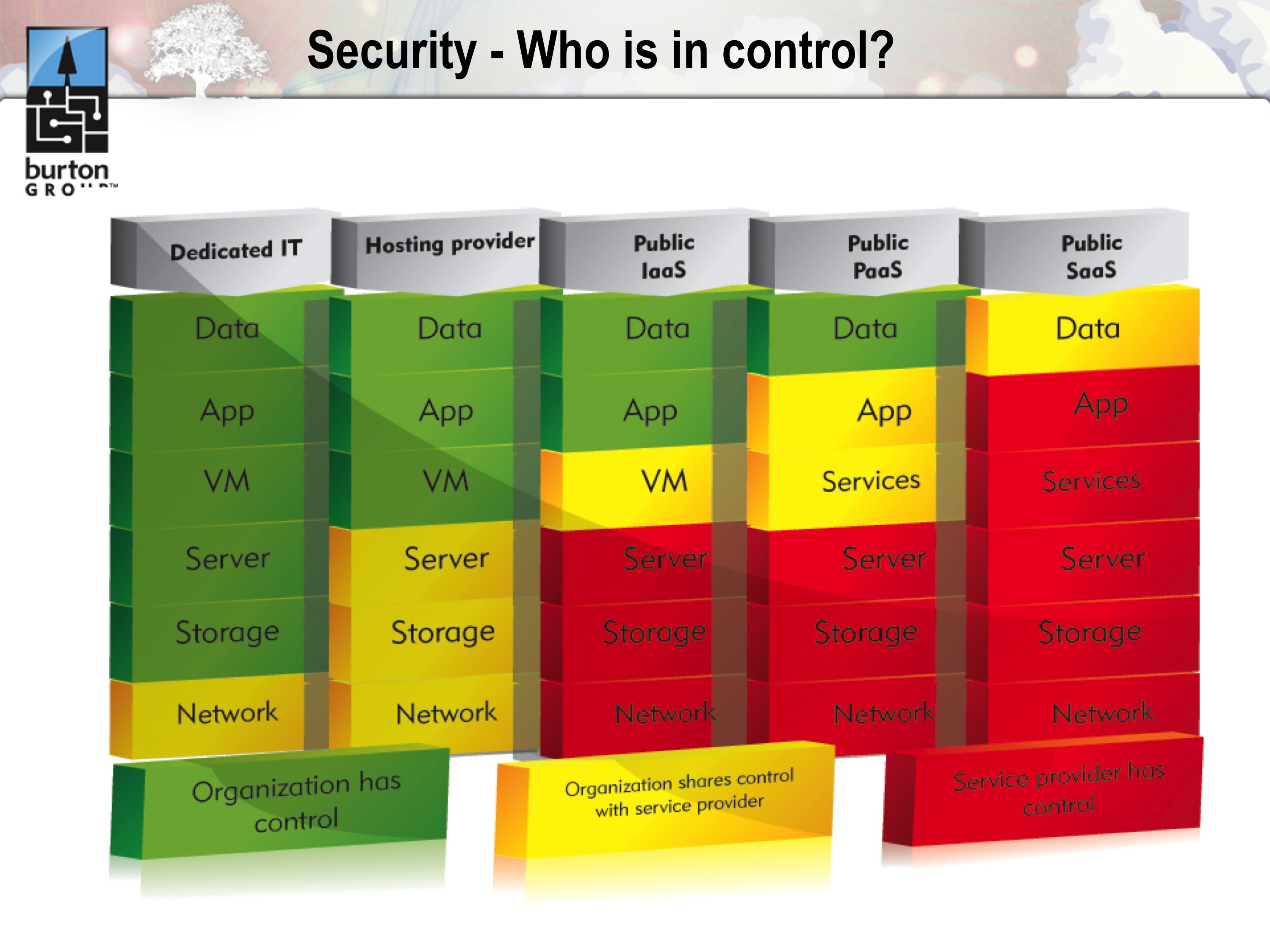
Two weeks ago, I delivered a webinar about new security models in the cloud with Anne Thomas Manes from Burton Group. Anne had one slide in particular, borrowed from her colleague Dan Blum, which I liked so much I actually re-structured my own material around it. Let me share it with you:

This graphic does the finest job I have seen of clearly articulating where the boundaries of control lie under the different models of cloud computing. Cloud, after all, is really about surrendering control: we delegate management of infrastructure, applications, and data to realize the benefits of commoditization. But successful transfer of control implies trust–and trust isn’t something we bestow easily onto external providers. We will only build this trust if we change our approach to managing cloud security.

Cloud’s biggest problem isn’t security; it’s the continuous noise around security that distracts us from the real issues and the possible solutions. It’s not hard to create a jumbled list of things to worry about in the cloud. It is considerably harder to come up with a cohesive model that highlights a fundamental truth and offers a new perspective from which to consider solutions. This is the value of Dan’s stack.

The issues in the cloud that scare us the most all fall predicatably out of the change in control this environment demands. Enterprise IT has carefully constructed an edifice of trust based on its existing on-premise security models. Cloud challenges these models. Cloud rips pieces from the foundation of this trust, leaving a structure that feels unstable and untrustworthy.

We cannot simply maintain existing security models in the cloud; instead, we need to embrace a new approach to security that understands the give-and-take of control that is inherent to the cloud. This demands we recognize where we are willing to surrender control, acknowledge that this conflicts with our traditional model, and change our approach to assert control elsewhere. Over time we will gain confidence in the new boundaries, in our new scope of control, and in our providers–and out of this will emerge a new formal model of trust.

Let’s consider Infrastructure-as-a-Service (IaaS) as a concrete example. Physical security is gone; low-level network control is gone; firewall control is highly abstracted. If your security model–and the trust that derives from this–is dependent on controlling these elements, then you had better stay home or build a private cloud. The public cloud providers recognize this and will attempt to overlay solutions that resemble traditional security infrastructure; however, it is important to recognize that behind this façade, the control boundaries remain and the same stack elements fall under their jurisdiction. Trust can’t be invested in ornament.

If you are open to building a new basis for trust, then the public cloud may be a real option. “Secure services, not networks” must become your guiding philosophy. Build your services with the resiliency you would normally reserve for a DMZ-resident application. Harden your OS images with a similar mindset. Secure all transmissions in or out of your services by re-asserting control at the application protocol level. This approach to secure loosely coupled services was proven in SOA, and it is feasible and pragmatic in an IaaS virtualized environment. It is, however, a model for trust that departs from traditional network-oriented security thinking, and this is where the real challenge resides.

How Secure is Cloud Computing?

Technology Review has published an interview with cryptography pioneer Whitfield Diffie that is worth reading. I had the great pleasure of presenting to Whit down at the Sun campus. He is a great scientist and a gentleman.

In this interview, Diffie–who is now a visiting professor at Royal Holloway, University of London–draws an interesting analogy between cloud computing and air travel:

“Whitfield Diffie: The effect of the growing dependence on cloud computing is similar to that of our dependence on public transportation, particularly air transportation, which forces us to trust organizations over which we have no control, limits what we can transport, and subjects us to rules and schedules that wouldn’t apply if we were flying our own planes. On the other hand, it is so much more economical that we don’t realistically have any alternative.”

Diffie makes a good point: taken as a whole, the benefits of commodity air travel are so high that it allows us to ignore the not insignificant negatives (I gripe as much as anyone when I travel, but this doesn’t stop me from using the service). In the long term, will the convenience of cloud simply overwhelm the security issues?

The history of computing, of course, is a history full of such compromise. Right now we are in the early days of cloud computing, where all of us in the security community are sniping at the shortcomings of the technology, the process, the legal and regulatory issues, and anything else that appears suspect. But truthfully, this is the ultimate low hanging fruit. Identifying problems with the cloud is effortless; offering real solutions is considerably harder.

Not surprising, Diffie offers a real solution, which is to look hard at trusted platforms. In the end, convenience will sweep over us all, so it is important to quickly establish the best secure baseline we can. The secure base for cloud computing needs to become like aircraft maintenance schedules–something that is a given part of the process and an important component that allows us to reasonably invest trust in the system as a whole.

Webinar Available: New Security Model Requirements for the Cloud

Last week, Anne Thomas Manes, Research Director from Burton and I did a Webinar entitled New Security Model Requirements for the Cloud. It’s probably generated the most feedback of any webinar I’ve done. It’s now online, so have a look at it here.

Podcast: How to Ultimately Secure the Cloud

I had a great discussion with Mike Vizard of CTOEdge the other day about how to secure the cloud. I was joking with Mike afterward that I had tried to avoid delivering any overt vendor message because this is such an important topic. Nevertheless, some SecureSpan specific features had leaked into the discussion. He thought that I had actually done better than most: it turns out I was 18 minutes into it before I slipped into vendor-speak.

You can judge for yourself. Listen to the podcast here.


Is Cloud Computing Secure? Prove It

I had a discussion with Wayne Rash the other day about security in cloud computing. He followed up with an excellent article in eWeek with the provocative title Is Cloud Computing Secure? Prove It. I’d encourage you to have a look; Wayne spoke to a number of well-known people in the industry, and they offer up some valuable insights in his piece.

Wayne is interesting to talk to. He’s a retired naval officer who has been in the IT business long enough to have earned a very broad perspective.  Cloud has a lot of roots in earlier technologies (virtualization, time sharing, ASPs, outsourced data centres, etc). I find that it’s always instructive to discuss cloud computing with people like him who recognize not just the similarities, but also the differences between cloud and its antecedents.

If you ever meet Wayne, be sure and ask him about his experiences with Rear Admiral Grace Hopper.

Integrating SecureSpan Gateways and Sun’s OpenSSO

François Lascelles, who is Technical Director for Europe here at Layer 7, has just published an excellent article on Sun’s Developer Network site titled Delegating XML Gateway Runtime Authorization to OpenSSO. It goes into detail about how entitlements in Sun’s OpenSSO can be enforced for Web services, XML, and REST transactions using a SecureSpan Gateway and OpenSSO server.

This combination of Policy Decision Point (PDP)–in this case, OpenSSO–and Policy Enforcement Point (PEP)– the Layer 7 SecureSpan Gateway–is a common deployment pattern for us. Most organizations have already made PEP PDPan investment in Identity and Access Management (IAM) infrastructure; however, this is not sufficient on its own for SOA access control. That’s where Layer 7 can help. Deployed in combination with an IAM system like OpenSSO, SecureSpan does the heavy lifting of XML processing and enforcement, but delegates the access control decision process (and often identity token validation) to the existing, familiar IAM infrastructure. It’s a powerful combination, and one that extends existing investment in IAM into the SOA world.


Over the past seven years, we’ve built connectors into virtually all of the IAM systems out there. When we built SecureSpan, we were careful to build an effective framework for authentication and authorization so that it’s easy to build connectors into different systems. This is important, because unfortunately the IAM marketplace evolved rapidly and without a lot of standardization.

Have a look at François’ article. He’s been with the company since it’s beginning, and has as broad a perspective on this area as you will find.

SOA Security Can Be Simple

I wrote earlier in the week about Randy Hefner’s article that characterized the present state of SOA security as “good enough and getting better”. If you design your security architecture well, you can iterate on it and implement more sophisticated security models as you need them. This is something I agree with completely–in fact, this is the guiding principle behind how we build the SecureSpan Gateway product line here at Layer 7. But I’m a vendor; of course I’m going to say that. Instead, let me prove it using some real examples.

Suppose we have a simple warehouse application we want to make available to our field staff. The application resides deep inside our corporate network, and our field staff need to use the public Internet to access it. The good news is that this application publishes a service composed of four simple operations:

Warehouse Service

  • listProduct()
  • getProductDetails()
  • placeOrder()
  • currentOrders()

This will make it easy to build clients that can access it. The bad news is that it has no security protecting it in any way, as it’s been assumed to be in a secure environment.

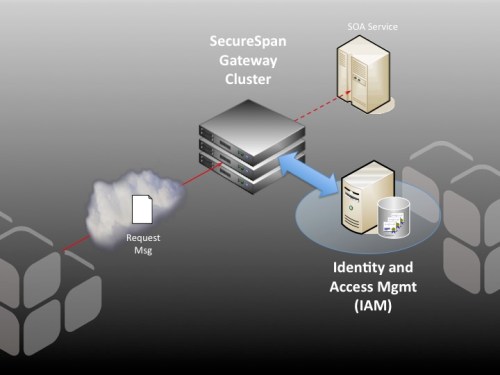
We’ll use a SecureSpan Gateway in front of the application to be the secure “front door” to these services. The Gateway will provide policy-based security, that can be easily administered by a dedicated security professional–not the developers who wrote the original warehouse app. This is what Randy and Forrester recommend as a best practice. Here’s how it looks:

A simple, edge-of-network deployment of a SecureSpan Gateway as a border guard for internal services.

A simple, edge-of-network deployment of a SecureSpan Gateway as a border guard for internal services.

Scenario #1: Simple SSL

Randy suggested that given the right architecture, you can begin with a simple security model and evolve it. That’s what I’ll do here.  I’ll begin with a very simple, uniform security policy governing access to the service:

Policy #1

  1. Incoming connection must use SSL
  2. Send the request content to the internal warehouse service.

I’ll admit that this isn’t much of a security model–it has no authentication, authorization, or audit. But it does illustrate how you can layer on some simple policy to the internal service: here, by only accepting connections that are using SSL. Thus, we’ve put a constraint on the system that between the external client and the SecureSpan Gateway we must have confidentiality and integrity.

Policies are created in the SecureSpan Manager, which is the administration console for single gateways or clusters (a logical grouping of gateways that shares policies and critical state info and is administered as a whole). The SecureSpan Manager has a useful wizard that allows you to compose basic security policies using only the WSDL description of a service as input. I won’t demonstrate it here, but instead skip to the wizard output, which is an executable policy:

basic SSL reverse proxy

This policy will be executed automatically whenever the Gateway receives a message destined for the warehouse service. It’s composed of just two assertions that implement the policy requirements we listed above. In SecureSpan, assertions are strung together into algorithms that describe how the gateway should process a stream of XML content. SecureSpan ships about 100 standard assertions. These can be used to do everything from authentication, transformation, SLAs, routing to different transports, audit, logical flow control, orchestration, etc. There’s also a pluggable model for building your own custom assertions, which you can use to solve those unusual problems that can’t be overcome with basic components. It’s a lot like the shell scripting philosophy in Unix: give people a kit of basic sharp tools and there’s no limit to what they can build.

Scenario #2: Add Client-side Certificate Authentication and Authorization

Suppose we want to add client authentication to the policy. There are dozens of different authentication modes in the Web services standards, and a number of informal ones we see regularily in the field. We support virtually all of these. In this example, let’s use client-side certificates, and let’s add an authorization component to only permit people in the sales group to access  the warehouse service:

Policy #2:

  1. Incoming connection must use SSL
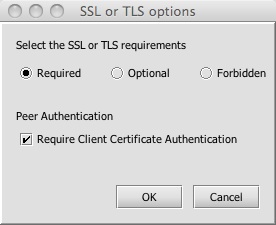
  2. Client must be challenged for a certificate, and this certificate must be valid, and be issued by an authority we trust
  3. Client must be in the sales group, as defined in the gateway internal identity provider
  4. Send the request content to the internal warehouse service (as before).

Think about what you would have to accomplish to implement this on the application server you host your services on. Now think about getting this consistent across a farm of servers. Finally, consider how you would maintain this consistently across different systems, like Microsoft .NET and WebSphere. It’s a big challenge. In contrast, here’s what it looks like in SecureSpan:

ssl authN

Notice the first assertion now declares that it will challenge the client to authenticate itself using the client-side certificate authentication protocol built into SSL. This is configured by adjusting the assertion details, which are accessible by double-clicking the assertion:

ssl detail

I’ve added a new assertion that adds authorization (or entitlements) by imposing group membership requirements. I simply dragged it in from our palette and dropped it into the policy. Here, I’m leveraging group definitions that were defined using our internal identity provider. This is a localized directory shared across SecureSpan Gateway clusters. Administrators create identities here, define groupings, and issue certificates using the Gateway’s integrated Certificate Authority (CA) capability. These features are convenient because they allows you to work with identity-centric policies without being forced to call out to an external LDAP, Identity and Access Management (IAM) system, or PKI authority. (Of course, if you want to go external, we have connectors into, well, pretty much all of them.) The internal identity provider is very useful for testing or development–and demonstrations like this where we are trying to keep things simple.

Scenario #3: OASIS Web Services Security WS-S Message-based Security

Now let’s make a really radical change to our security model. We’ll move from transport-level, SSL security to a more sophisticated message-based security model. This supports different transports–such as going over a JMS Message-Oriented Middleware (MOM) provider like MQSeries, or transfer of XML content as a file over FTP. It can handle asynchronous, and non point-to-point messaging, which are difficult or impossible to achieve using connection-based SSL.  Here’s the new policy:

Policy #3:

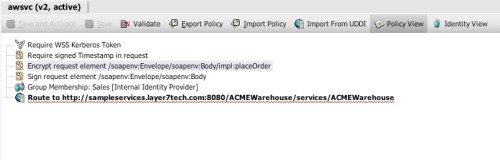
  1. Authenticate identity using the OASIS WS-Security Kerberos Token Profile
  2. Ensure that the message contains valid, digitally signed time stamps. These could be used to add uniqueness in the message as a means to defeat replay attacks (there are various other strategies to achieve this as well).
  3. If the operation requested is placeOrder(), decrypt the order contents elements in the message using the AES-192 cipher, a symmetric key encryption mechanism. Do this in compliance with the OASIS WS-Security standard.
  4. Regardless of the operation, ensure that there is a valid signature spanning the body of the message to ensure that nothing was altered in transit. This also establishes a binding between the content and the identity we validated in step #1.
  5. Client must be in the sales group, as defined in the internal identity provider (as before).
  6. Send the request content to the internal warehouse service (as before).

Our security model is becoming fairly complex, and it’s important to note that it is by no means complete. We haven’t even begun to address how the response from the service should be handled (right now it’s just relayed unaltered from the service); however to keep things simple in the example we’ll confine ourselves to this, knowing that it is incomplete.

Here’s what this policy looks like in the SecureSpan Manager. Note that it’s simple to read and understand, which is important when designing security implementations. Complexity increases the chances of errors going undetected:

wss 1

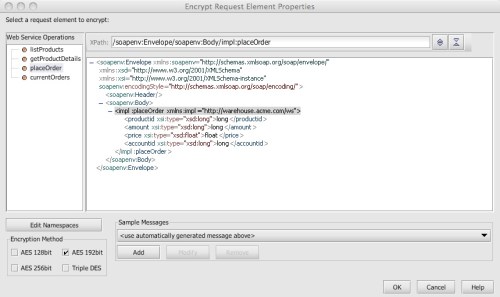
To write this I simply deleted the SSL assertion and dragged in four new ones. To configure the encryption on a particular element, I opened the detail pane of the encrypt request element assertion:

encrypt

This pane reflects on the schema bound to the original WSDL that describe the warehouse service. It allows me to just point at the elements I expect to find encrypted (or signed). The gateway takes care of the heavy lifting of XML decryption at run time using our acceleration technology. This panel provides a standard message stereotype to work with, or I can load a sample message to describe an even more realistic scenario.

The time spent converting from SSL-based security model to the much more sophisticated WS-Security policy was all of about 30 seconds. So what we’ve done here is shown how you can start simple, and grow your security model over time with very little effort or risk.

Simple SOA Security

When I was young my Dad was tough on tools. I quite clearly remember him stating “if your tools don’t work for you, get different tools”. This was usually followed by the offending tool being tossed into the garbage because it didn’t serve its intended purpose. A better one–one that solved the problem it was designed for–inevitably showed up soon after. Somehow, this has always stuck with me.

SOA tools need to work just as hard, and if they aren’t useful, they need to face a similar fate. SecureSpan Gateways need to offer flexibility, because the truth is, everyone has different integration challenges in the SOA world. But SecureSpan also needs to be simple enough to resist misconfiguration by virtue of the complexity of SOA security standards (more on this topic in a future post). These are actually two opposing forces, and it’s not trivial to find a useful balance between the two. SecureSpan has achieved that balance. When we do find case where it fails, our judgment is as unequivocal as my Dad’s around the chisels and wrenches in my his toolbox: replace it with something that works for you.