Tag Archives: cloud computing

Beatniks in the Cloud

I’ve always been a fan of the Beats. Back when I was young and cool, I played bass guitar in a band called the Subterraneans, inspired of course by Kerouac’s novella of his relationship in decay, set inside the jazz underworld of San Francisco. Just as punk rock was to the music of the 70s, the Beats were a necessary reaction to society and the literature of the time. They had an influence, though sadly their image has been reduced to little more than the media-drawn caricature of the Beatnik.

Beatniks, however, are a great vehicle for satire. I was greatly flattered when David Linthicum sent me a link to this video, which riffs off a blog post I did titled Visualizing the Boundaries of Control in the Cloud.

This video is one of a series that Novell has put together looking at real issues in cloud computing. There’s another great episode that picks up on a post Linthicum wrote considering the weighty topic of fear of multi-tenancy.

Well done, Novell. You have redeemed the Beatniks for me.

Live From New York, It’s… The Cloud Power Panel

Well, not really live, but definitely from New York. Just before the recent Cloud Computing Expo, Sys-Con asked me to join their 2010 Cloud Computing Power Panel, hosted by the multi-talented Jeremy Geelan. The panel consisted of me, Greg O’Connor, CEO of AppZero; Tony Bishop, CEO of Adaptivity; and Marty Gauvin, CEO of Virtual Ark. We did in fact film right above Times Square, using the Reuter’s studio. The facility was amazing, the crew was top notch, and the resulting video looks great.

You can watch the Cloud Power Panel here. We covered a range of topics, from why enterprises will inevitably end up using the cloud, to how they must think differently to be successful out there. We even found time to consider something called Father-as-a-Service (FaaS).

The Top 5 Mistakes People Make When Moving to the Cloud

Cloud is now mature enough that we can begin to identify anti-patterns associated with using these services. Keith Shaw from Network World and I spoke about worst practices in the cloud last week, and our conversation is now available as a podcast.

Come and learn how to avoid making critical mistakes as you move into the cloud.

All Things Considered About Cloud Computing Risks and Challenges

Last month during the RSA show, I met with Rob Westervelt from ITKnowledgeExchange in the Starbucks across from Moscone Center. Rob recorded our discussion about the challenges of security in the cloud and turned this into a podcast. I’m quite pleased with the results. You can pick up a little Miles Davis in the background, the odd note of an espresso being drawn. Alison thinks that I sound very NPR. Having been raised on CBC Radio, I take this as a great compliment.

Pour yourself a coffee and have a listen.

Upcoming Webinar: Security in the Cloud vs Security for the Cloud

I was speaking recently to Steve Coplan, Senior Analyst, Enterprise Security Practice at the 451 Group. I always enjoy talking to Steve. He has a deep understanding of technology and our business, but it’s his training as a journalist that I think sets him apart from the other analysts. His work comes through as erudite but accessible, and it is always very well written.

In our discussion, Steve was careful to make a clear distinction between between security in the cloud and security for the cloud. This intrigued me, because I think the differences are too often lost when people talk about cloud in the abstract. Steve’s point became the topic of a webinar that he and I will deliver together this Thursday, March 25, 2010 at 12:00pm EDT/9:00am PDT/4:00pm GMT.

I hope you can join us to learn why this distinction is so important. You can sign up for this webinar at the Layer 7 Technologies web site.

The Seven Deadly Sins: The Cloud Security Alliance Identifies Top Cloud Security Threats

Today marks the beginning of RSA conference in San Francisco, and the Cloud Security Alliance (CSA) has been quick out of the gate with the release of its Top Threats to Cloud Computing Report. This peer-reviewed paper characterizes the top seven threats to cloud computing, offering examples and remediation steps.

The seven threats identified by the CSA are:

  1. Abuse and Nefarious Use of Cloud Computing
  2. Insecure Application Programming Interfaces
  3. Malicious Insiders
  4. Shared Technology Vulnerabilities
  5. Data Loss/Leakage
  6. Account, Service, and Traffic Hijacking
  7. Unknown Risk Profile

Some of these will certainly sound familiar, but the point is to highlight threats that may be amplified in the cloud, as well as those that are unique to the cloud environment.

This CSA threats report is a true community effort. The working group had representatives from a broad range of cloud providers, infrastructure vendors, and cloud customers, including:

  • HP
  • Oracle
  • Bank of America
  • Microsoft
  • Rackspace
  • Verizon
  • Cigital
  • Qualsys
  • Trend Micro
  • Websense
  • Zscalar
  • CloudSecurity.org
  • Cloud Security Alliance
  • Layer 7 Technologies

I represented Layer 7. I tackled Data Loss/Leakage, and performed some editorial of the paper as a whole. As working groups go, I can tell you that this one simply worked well. I’ve been involved with a number of standards groups in the past, this time we seemed to have all of the right people involved. The group converged on the key issues quickly and decisively. It was a good process, and I’m happy with the results.

We thing we did debate was how best to rate each threat. We finally agreed that the best approach was to let the community decide You may recall that last week I wrote an blog entry soliciting your input to help classify threat severity. Well, the results are in and they are certainly interesting. Perhaps not surprising, the threat of Data Loss/Leakage leads the community’s list of concerns, at around 28%. But what is more intriguing is that there really isn’t too much of a difference between the perceived impact of any threat on the list (all fall between around 8-28%). This is encouraging, as it suggests that we nailed the current zeitgeist in our list. It is just a little disconcerting that there remain seven significant threats to consider.

The latest survey results, and the threats paper itself, are available from the CSA web site. Bear in mind that is evolving work. The working group intends to update the list regularly, so if you would like to make a contribution to the cloud community, please do get involved. And remember: CSA membership is free to individuals; all you need to give us is your time and expertise.

You Can Help the Cloud Security Alliance Classify the Top Threats in the Cloud

The Cloud Security Alliance (CSA) needs your help to better understand the risk associated with cloud threats. Earlier this year, the CSA convened a working group with the mandate to identify the top threats in the cloud. This group brought together a diverse set of security and cloud experts, including myself representing Layer 7. Our group identified 7 major threats that exist in the cloud, but now we would like to gauge how the community as a whole perceives the risk these threats pose.

I would like to invite you to participate in a short survey so we can get your input. This should only take you about 5 minutes to complete. We intend to work the results of this survey into the CSA Top Threats to Cloud Computing document. This will be formally unveiled at the Cloud Security Alliance Summit, which is part of next week’s RSA conference in San Francisco.

Help us to make the cloud a safer place by identifying and characterizing its greatest threats. Share this survey link with your colleagues. The more participation we can get, the better our results will be, and the stronger the work will become.

You will find our survey here.

My Thoughts on Cloud Security in SearchCloudComputing.com

I had a good talk the other day with Carl Brooks, the technology writer for SearchCloudComputing.com. We spoke about why security is different in the cloud, and what you can learn from approaches like SOA about how to secure cloud-based apps. The full interview is the lead story today on SearchCloudComputing.com.

Visualizing the Boundaries of Control in the Cloud

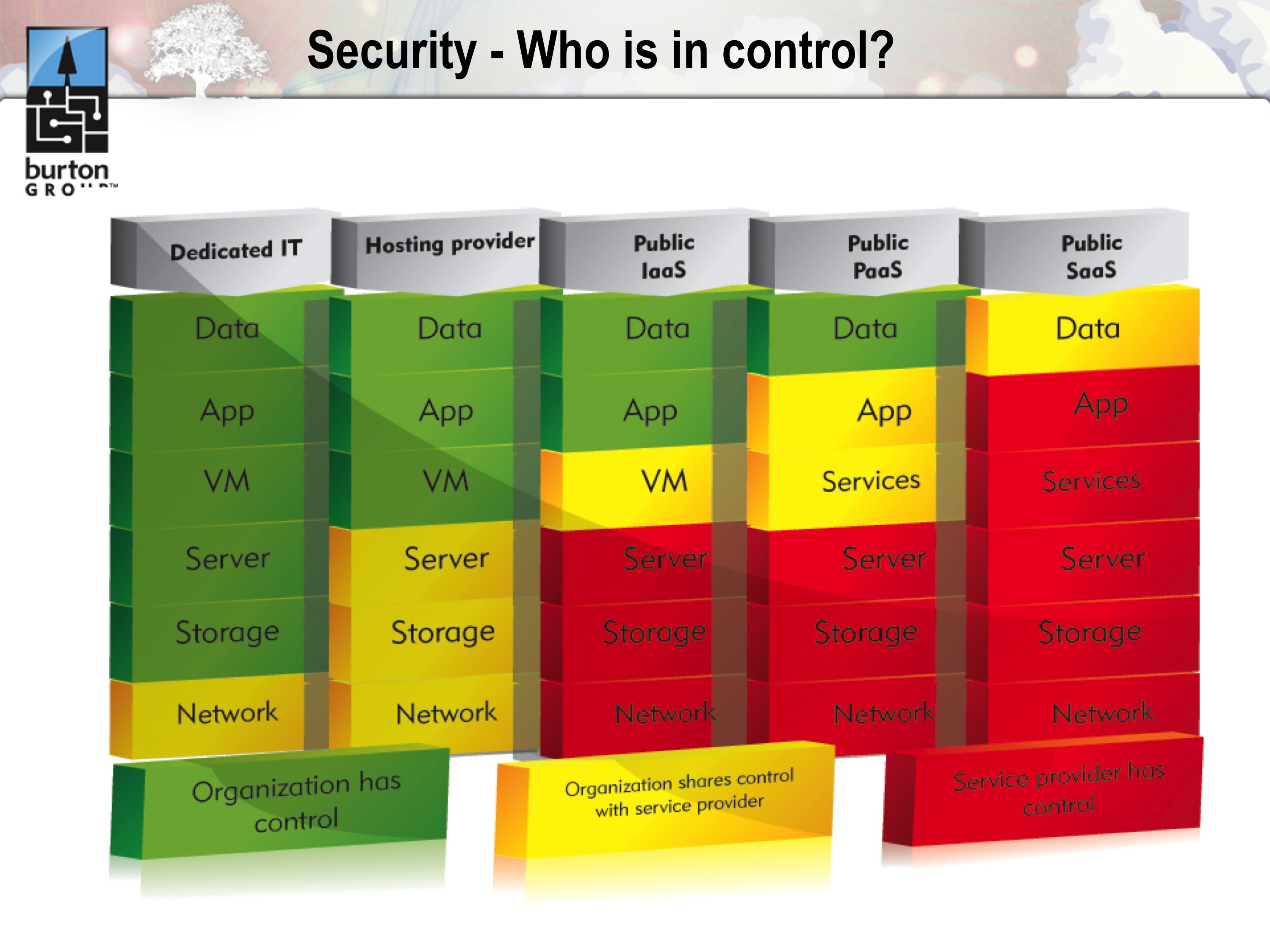
Two weeks ago, I delivered a webinar about new security models in the cloud with Anne Thomas Manes from Burton Group. Anne had one slide in particular, borrowed from her colleague Dan Blum, which I liked so much I actually re-structured my own material around it. Let me share it with you:
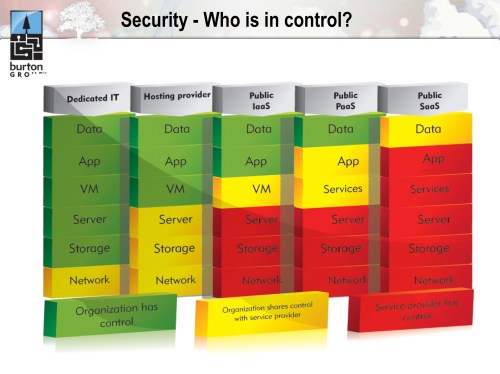
This graphic does the finest job I have seen of clearly articulating where the boundaries of control lie under the different models of cloud computing. Cloud, after all, is really about surrendering control: we delegate management of infrastructure, applications, and data to realize the benefits of commoditization. But successful transfer of control implies trust–and trust isn’t something we bestow easily onto external providers. We will only build this trust if we change our approach to managing cloud security.

Cloud’s biggest problem isn’t security; it’s the continuous noise around security that distracts us from the real issues and the possible solutions. It’s not hard to create a jumbled list of things to worry about in the cloud. It is considerably harder to come up with a cohesive model that highlights a fundamental truth and offers a new perspective from which to consider solutions. This is the value of Dan’s stack.

The issues in the cloud that scare us the most all fall predicatably out of the change in control this environment demands. Enterprise IT has carefully constructed an edifice of trust based on its existing on-premise security models. Cloud challenges these models. Cloud rips pieces from the foundation of this trust, leaving a structure that feels unstable and untrustworthy.

We cannot simply maintain existing security models in the cloud; instead, we need to embrace a new approach to security that understands the give-and-take of control that is inherent to the cloud. This demands we recognize where we are willing to surrender control, acknowledge that this conflicts with our traditional model, and change our approach to assert control elsewhere. Over time we will gain confidence in the new boundaries, in our new scope of control, and in our providers–and out of this will emerge a new formal model of trust.

Let’s consider Infrastructure-as-a-Service (IaaS) as a concrete example. Physical security is gone; low-level network control is gone; firewall control is highly abstracted. If your security model–and the trust that derives from this–is dependent on controlling these elements, then you had better stay home or build a private cloud. The public cloud providers recognize this and will attempt to overlay solutions that resemble traditional security infrastructure; however, it is important to recognize that behind this façade, the control boundaries remain and the same stack elements fall under their jurisdiction. Trust can’t be invested in ornament.

If you are open to building a new basis for trust, then the public cloud may be a real option. “Secure services, not networks” must become your guiding philosophy. Build your services with the resiliency you would normally reserve for a DMZ-resident application. Harden your OS images with a similar mindset. Secure all transmissions in or out of your services by re-asserting control at the application protocol level. This approach to secure loosely coupled services was proven in SOA, and it is feasible and pragmatic in an IaaS virtualized environment. It is, however, a model for trust that departs from traditional network-oriented security thinking, and this is where the real challenge resides.


How Secure is Cloud Computing?

Technology Review has published an interview with cryptography pioneer Whitfield Diffie that is worth reading. I had the great pleasure of presenting to Whit down at the Sun campus. He is a great scientist and a gentleman.

In this interview, Diffie–who is now a visiting professor at Royal Holloway, University of London–draws an interesting analogy between cloud computing and air travel:

“Whitfield Diffie: The effect of the growing dependence on cloud computing is similar to that of our dependence on public transportation, particularly air transportation, which forces us to trust organizations over which we have no control, limits what we can transport, and subjects us to rules and schedules that wouldn’t apply if we were flying our own planes. On the other hand, it is so much more economical that we don’t realistically have any alternative.”

Diffie makes a good point: taken as a whole, the benefits of commodity air travel are so high that it allows us to ignore the not insignificant negatives (I gripe as much as anyone when I travel, but this doesn’t stop me from using the service). In the long term, will the convenience of cloud simply overwhelm the security issues?

The history of computing, of course, is a history full of such compromise. Right now we are in the early days of cloud computing, where all of us in the security community are sniping at the shortcomings of the technology, the process, the legal and regulatory issues, and anything else that appears suspect. But truthfully, this is the ultimate low hanging fruit. Identifying problems with the cloud is effortless; offering real solutions is considerably harder.

Not surprising, Diffie offers a real solution, which is to look hard at trusted platforms. In the end, convenience will sweep over us all, so it is important to quickly establish the best secure baseline we can. The secure base for cloud computing needs to become like aircraft maintenance schedules–something that is a given part of the process and an important component that allows us to reasonably invest trust in the system as a whole.